


Cash Arrows
4.4617.00 Reviews
App Specs
- Version
- 1.0.1.0
- Updated On
- License
- Free
- Downloads
- 5,000,000+
- Developer
- StatusWorld
- Categories
- Casual
- Platform
- Android
Screenshots


 Analysis by AppCompare
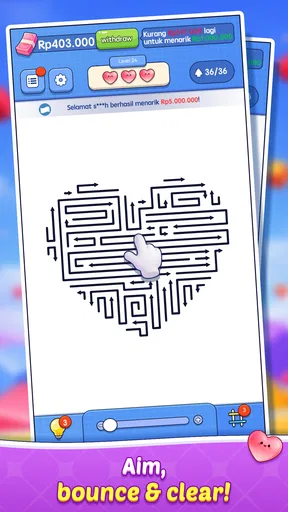
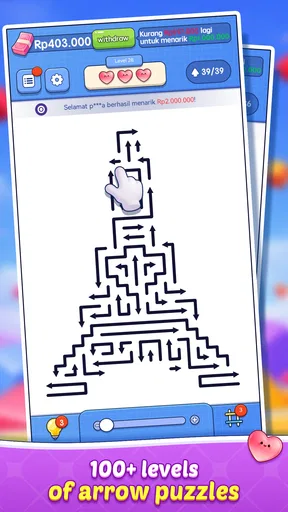
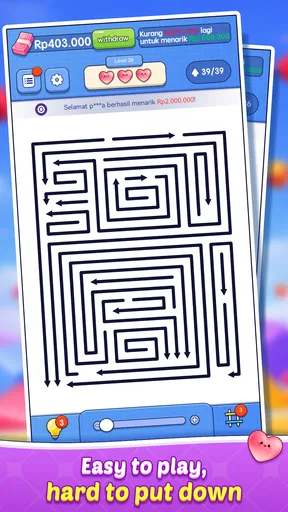
I spent time with Cash Arrows as a quick, casual puzzle game built around one simple task: bouncing, aiming, and clearing arrows from the board. That sounds easy at first, and the early appeal comes from how quickly a short attempt turns into a small problem-solving exercise. I found myself opening it for a brief distraction, then staying longer because each arrangement invited one more try.
The basic idea is easy to understand without a tutorial-heavy introduction. You look at the arrow layout, consider how a shot will travel or bounce, and try to remove everything efficiently. That makes it approachable for players who want a game they can start immediately rather than learn through a long progression system. At the same time, the limited space for mistakes gives the otherwise relaxed presentation a little pressure.
StatusWorld presents the game as a free casual title for Android, with a mature audience rating of 17 and over. It has reached more than five million installs and holds an average rating of 4.4 from roughly two hundred thousand ratings, so it is clearly attracting a substantial audience. I would still treat those figures as a reason to investigate rather than a substitute for personal preference: the real question is whether its compact arrow puzzles match the way you like to play.
How Cash Arrows feels during ordinary play
I judge Cash Arrows most fairly in the ordinary moments it is built for: a quick pause, a few decisions, and a chance to stop when I’m ready. That makes the feel of each attempt more useful to consider than any promise of marathon play. It also leads naturally to the question of how the game holds up when a short session turns into a longer one.
Simple controls, but decisions matter quickly
The strongest part of the design is the gap between simple interaction and increasingly careful decision-making. Aiming does not require complicated controls, yet the order in which you approach the arrows can change the whole result. I learned to pause for a moment before acting instead of immediately tapping the most obvious target. That small habit makes the game feel more thoughtful and reduces the frustration of wasting an otherwise useful move.
For a casual game, this is an important balance. If every board were solved by pointing at the nearest arrow, the novelty would disappear quickly. If every arrangement demanded long calculations, it would stop being suitable for short breaks. Cash Arrows works best in the middle: I can understand the objective at a glance, but I still need to read the layout and anticipate what a bounce will do.
My practical advice is to treat the first few seconds of a level as planning time. Look for arrows that block a larger route, identify spaces where a bounce could clear several pieces, and avoid committing to a shot simply because it is available. This is more useful than playing at maximum speed, especially when the board creates a chain of possible directions.
Worth Reading Before You Choose

EA SPORTS FC Mobile 26 Is a Bigger Football Game, but It Takes Time

Flipboard Shows What News Apps Must Do Beyond the Feed

Switching to Android Auto Means Rethinking Your Driving Routine

Google Calendar Makes a Crowded Week Easier to Manage

Ludo King Makes the Most of the Minutes Between Plans

Baby Panda World Brings Quick Play to Modern Phones, but Its Game Library Feels Busy
A good fit for short sessions
I can see this game fitting naturally into everyday moments such as waiting for an appointment, taking a short break from work, or sitting on public transport. It does not ask me to remember a complicated story or maintain a large collection of characters. I can play one small puzzle, put the phone away, and return later without needing to reconstruct a narrative.
That convenience is also its main limitation. Players looking for a deep role-playing game, a long campaign, or a social competition will probably find the experience too focused. Cash Arrows is about the immediate satisfaction of solving the current arrangement, not about building a large world around the puzzle. I would recommend it to someone who enjoys compact challenges, but not to a friend who needs constant variety outside the central mechanic.
Where the pressure comes from
The game’s pressure is not based on a complicated rule set. It comes from the possibility of making a poor choice when the board looks almost solved. A careless shot can leave an awkward final arrow, while a more patient route may clear the same space cleanly. That makes failure feel connected to my decision rather than to an unclear control scheme.
Still, this style can become repetitive if the arrangements do not keep offering meaningful alternatives. The appeal depends heavily on whether I feel that I am solving a fresh spatial problem rather than repeating a familiar pattern. I enjoyed the strongest moments when several routes looked plausible and I had to choose between a safe move and a more efficient one.
One useful way to manage that pressure is to separate “progress” from “perfection.” If I am playing during a short break, I focus on understanding why a level went wrong instead of replaying immediately in frustration. If I have more time, I try a different opening move and compare the result. That approach keeps the game relaxing instead of turning every failed attempt into a chore.
Spending and the question of fairness
The game is free to download, which makes trying it straightforward. However, the information available for the title does not establish a purchase price, an item shop, advertising arrangement, subscription, or any specific paid advantage. I therefore would not claim that the game is fully free of spending pressure, nor would I suggest that payment is necessary to progress. Those are details I would personally check in the app before deciding whether to keep it installed.
That distinction matters because a puzzle game can feel very different depending on how it handles retries, interruptions, or optional assistance. If a player is asked to spend money after a mistake, the perceived fairness changes even when the core puzzle is enjoyable. My approach would be simple: play several sessions without entering payment details, observe whether the normal loop remains comfortable, and only consider spending if the terms are clear and the purchase is genuinely optional.
I also would not use the large install count or the strong average rating as evidence that the monetization is fair. Popularity can tell me that many people are willing to try the game, but it cannot explain how the game treats free players. For a title built around short repeated attempts, transparency around retries and interruptions is more important to me than a large audience figure.
Competitive fairness without assuming a competition
Cash Arrows feels primarily like a personal puzzle experience rather than a game I would choose for direct competition. That is good news for players who want to improve privately, because my enjoyment does not depend on matching another person’s schedule or skill. I can concentrate on cleaner solutions and better choices at my own pace.
At the same time, I would be careful about comparing scores or completion results unless the game clearly explains how they are calculated. A score can be influenced by moves, time, retries, assistance, or other rules, and those differences matter if players are judging one another. Without clear competitive context, I would treat any personal result as a measure of my own improvement rather than proof that I am better than another player.
This is where the game may suit some puzzle fans better than alternatives. Traditional match-three games often rely on rapid reactions, random tile combinations, and escalating visual effects. Cash Arrows offers a more deliberate spatial task: the satisfying moment comes from finding a route through the board. On the other hand, players who enjoy leaderboards, multiplayer battles, or elaborate daily challenges may prefer a puzzle title that makes those systems central and explicit.
Small habits that improve the experience
My first practical tip is to inspect the entire board before choosing the opening shot. The most visible arrow is not always the best starting point, and a move that looks productive can remove the angle needed for a later bounce. This habit costs only a moment but makes the game feel more strategic.
My second tip is to watch the remaining space rather than focusing only on the arrow being targeted. When the board becomes less crowded, the important question changes from “What can I clear now?” to “What positions will still be available afterward?” Thinking one step ahead is especially helpful when several arrows appear to interact.
My third tip is to use a failed attempt as a route test. Instead of repeating the same opening automatically, remember which area became blocked or which bounce produced an awkward result. Then change one decision at a time. That turns retries into useful experiments and helps reveal whether a level rewards careful sequencing or simply demands a different angle.
These habits are not complicated hidden systems; they are ways of getting more value from the game’s central mechanic. They also explain why I would not judge it solely by the store summary. The enjoyment comes from learning how to read each arrangement, not from the description alone.
Who should install it
I would point Cash Arrows toward someone who likes casual puzzles with immediate rules and short, repeatable sessions. It is particularly suitable for players who enjoy visual planning, controlled experimentation, and the satisfaction of clearing a board after a few thoughtful attempts. The free entry point makes it easy to test without committing to a purchase at the start.
I would be more cautious about recommending it to someone who dislikes retries or becomes annoyed when a nearly solved puzzle fails because of one early decision. The same structure that makes a successful solution satisfying can make a mistake feel disproportionately irritating. The mature 17-and-over content rating is another reason families should not assume that its simple puzzle format makes it appropriate for younger players.
It may also be the wrong choice for anyone seeking a strong sense of long-term progression. I did not approach it as a collection game, a narrative adventure, or a competitive arena. If your ideal mobile game gives you new characters, equipment, story chapters, or a large social layer, a different category will probably serve you better.
Device and version context
The current version is 1.0.1.0, and the listed minimum operating system is Android 7.0. That gives the game a reasonably broad Android starting point, although actual comfort will still depend on the phone’s screen, responsiveness, and how well the interface suits your hand. I prefer testing the aiming interaction on my own device rather than assuming that every screen will feel identical.
Because the title is built around visual positioning, touch accuracy matters more than it would in a menu-driven game. A cramped display, a damaged screen, or a case that interferes with edge touches could make precise shots less pleasant. If you play on an older phone, I would pay attention to whether movement and input feel immediate, since even a small delay can undermine a puzzle based on direction.
What I would check before settling in
Before making Cash Arrows a regular game, I would look at the opening experience and decide whether the pace matches my expectations. Does it let me solve several boards without unnecessary interruption? Are the rules explained clearly? Do retries feel like a normal part of learning, or do they create pressure to spend? These questions are more useful than assuming the game follows the same model as another casual puzzle.
I would also check the wording around any optional purchase or assistance when it appears. Since the available product facts do not identify specific paid features, I would avoid promising that every player receives the same experience. A transparent explanation of what a purchase changes would make me more comfortable; vague prompts would make me keep the game as an occasional pastime rather than a daily habit.
The same caution applies to competitive claims. If the game later presents rankings or performance comparisons, I would want to understand whether everyone is playing under the same conditions. Without that clarity, I would use the game for personal relaxation and improvement, not as a serious measure of puzzle skill.
My trust verdict
Cash Arrows succeeds when I want a focused puzzle that can be understood quickly but rewards a little patience. Its arrow-and-bounce concept gives ordinary short sessions a clear purpose, and the best boards encourage me to plan instead of tapping randomly. StatusWorld has chosen a narrow idea rather than burying the player under systems, which is exactly why the game can work as a break-time companion.
My recommendation comes with boundaries. I would not describe it as a complete replacement for deeper puzzle games, and I would not assume that a free download automatically means a friction-free experience. I would first check how the game handles retries, interruptions, and any optional spending, then decide whether those choices respect the way I want to play.
For me, the verdict is positive but measured: install it if you enjoy compact spatial challenges and want something you can pick up without preparation. Skip it if you need story, multiplayer competition, or substantial progression beyond clearing the next arrangement. The game’s real strength is the small moment when a carefully planned bounce removes the final obstacle. When that moment arrives without unnecessary pressure, Cash Arrows is an appealing casual puzzle; when you want much more than that, its focused design may feel limiting.
Pros
- Simple interface makes it easy to start earning rewards.
- Offers multiple ways to collect points beyond playing games.
- Low-effort tasks can be completed during short breaks.
- Progress tracking helps users monitor points and activity.
- Suitable for users looking for casual
- non-competitive entertainment.
Cons
- Rewards may vary by region and may not be available to everyone.
- Some tasks can disappear or change without prior notice.
- Earning potential is generally limited and not a reliable income source.
- The app may require personal details for account or payout verification.
- Frequent advertisements can make the experience feel repetitive.
FAQs for Cash Arrows
What is Cash Arrows and how does it work?
Cash Arrows is a rewards-style mobile app that presents users with activities such as viewing advertisements, completing offers, or interacting with in-app content in exchange for points. After collecting enough points, users may be able to request a reward through the available redemption options. The exact activities, point values, and reward conditions can change, so it is important to review the current rules inside the app.
Can Cash Arrows really pay users real money?
Cash Arrows may advertise the possibility of earning cash or other rewards, but the amount a user can receive depends on available tasks, eligibility, minimum withdrawal limits, and the app’s verification process. Earnings should not be considered guaranteed income. Before spending significant time on the platform, check recent user feedback, redemption requirements, processing times, and whether the payment methods offered are supported in your country.
Is Cash Arrows free to download and use?
The app may be free to download, but free access does not necessarily mean that every feature is unrestricted. Cash Arrows can include advertising, optional offers, or activities that require additional permissions or account information. Review the store listing and privacy policy before installation, and avoid paying money or sharing sensitive financial details unless the purpose is clearly explained and you are comfortable with the associated risks.
How do withdrawals work in Cash Arrows?
Withdrawal procedures can vary according to the user’s location and the reward options currently available in Cash Arrows. Typically, users must reach a minimum balance, select a supported payment method, and complete any requested account or identity verification. Processing may take time, and some requests can be rejected if activity violates the terms. Always confirm the minimum threshold, fees, and estimated processing period before redeeming points.
Is Cash Arrows safe to install and use?
As with any rewards app, safety depends on the permissions requested, the information collected, and how the developer handles user data. Download Cash Arrows only from an official app store, examine the developer details, and read the privacy policy before creating an account. Be cautious if the app requests unnecessary permissions, asks for payment credentials through unofficial channels, or promises unusually high earnings for very little effort.


